
It’s the middle of summer when I’m recording this; a time we don a pair of shades, a beach towel and a good book. Funnel Reboot usually shares talks with marketing book authors, but for this show I’m going to share some reads that go a little farther afield.
Come along with me through six books that are all amazing. The subjects range between business, humanities, technology and science fiction.
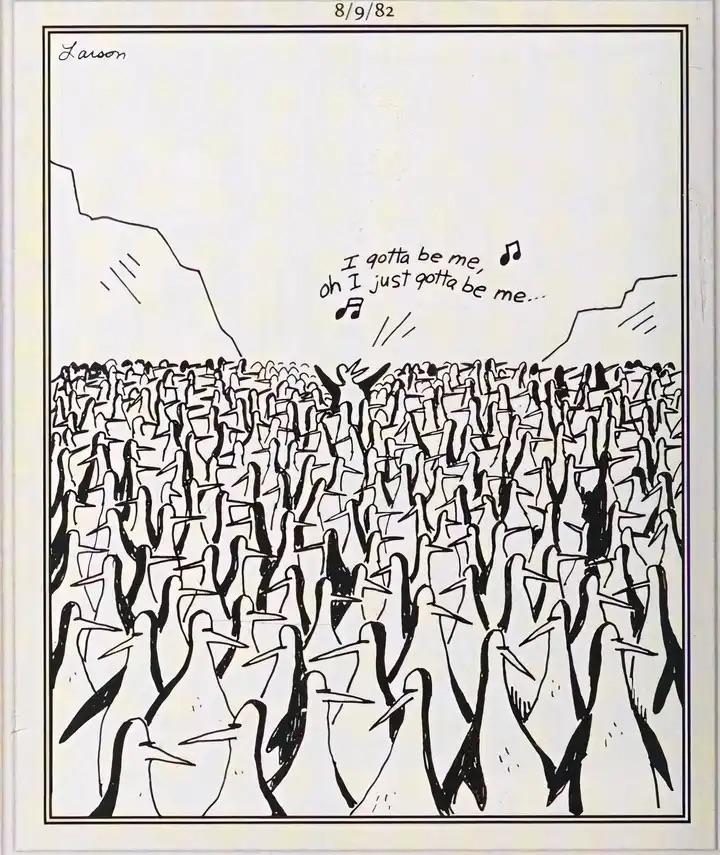
We as consumers do a lot of things just because the people around us are doing them. For proof, look no further than some historical examples—from the 17th-century tulip bulb craze in Holland to doomsday cults and prepper movements in the lead-up to Y2K. Buying fads such as pet rocks, fidget spinners, Beanie Babies, and NFTs all show how easily prevailing thoughts influence individual behavior.
The science behind this is well understood. The evolutionary drive to fit in with our peers is very strong. When a group of people’s purchases are plotted as a histogram, we always see the majority of them clumped near the centre – we see it so often we came up with a term for it – the Bell curve.
So even when people think they are expressing themselves, showing individuality by their brand choices, they are only veering slightly away from the norm.
Hey, Glenn here—welcome to Funnel Reboot. Our guest today—who I really do think has positively impacted marketers’ careers—argues that marketers are just as susceptible to conformity as consumers are. We get caught up in prevailing marketing practices when doing our job, while ignoring better marketing options. That’s a recipe for mediocre results.
Our guest is the author of three marketing books and the co-founder of an eight year old digital agency that has attracted clients whose annual spend ranges from thousands to millions of dollars. What does he credit for this marketing success? The time he’s spent on the edges of the Bell curve – doing things that most of us view as too far outside of our comfort zone. And he says to be a better marketer, you too should reject the orthodoxy of conventional marketing.
Unorthodox is the name of his latest book, and I’m glad to welcome back for a second time, Gil Gildner.
When it comes to initiatives humans undertake, we only need to look at a few to see how they can fail spectacularly. One example:
The iconic Sydney Opera House came from a competition won by a young Danish Architect. The board who’d commissioned him to build it was told it would be completed by 1963, but things were so chaotic and so behind schedule, he had to be fired. It is truly a marvel of design, but it’s a posterchild for poor projects because it didn’t open until 1973.
Another example: Out of a desire to research high-energy particles and potentially solve the fundamental of physics, the US Government set out to build the Superconducting Super Collider (SSC). A site in Texas was chosen, but after 6 years they had only tunneled a fraction of the 88 kilometres, when the project was cancelled at a cost of $2B.
A last example: In 1998 NASA’s Mars Climate Observer travelled about 200M miles and was about to start researching the red planet. But the software setting its orbital altitude had been given imperial units instead of metric. This error in the code made it come in too steep, destroying the $328M probe.
These failures are so huge, it’s bound to bring out our inner cynic. It’s natural to pose questions of those leading the projects, like: “what were they thinking?”
I don’t scoff at the people who headed these projects, because I experienced something in my youth that showed me how humans sabotage missions.
When I was 15 I attended a camp that took us through exercises to cultivate teamwork. I thought I knew what teamwork was; I was not prepared for what awaited.
Two twenty-something Senior Counselors named Leo & Bob were in charge of it. We left the camp which was in rural New York State and drove in a van a few hours away. The van crossed into Pennsylvania, left the highway for a sideroad, then onto a dirt road and finally to a clearing somewhere in the backwoods. It was early afternoon by the time Leo dropped us off, leaving 4 of us and Bob to calmly walk for about 30 minutes, and we stopped to relax in a clearing in the forest.
At that point, Bob stood facing us and told us about this simple exercise we were about to do. He said, ‘you are stranded in a forest a few miles from a stationary van which contains food and medical provisions. You have to locate the help, which will signal its location by a horn-blast every 15 minutes until sundown. You’ll succeed in your mission if you reach the van by then. He didn’t tell us what would happen if we didn’t.
All of this seemed doable, until Bob said one of your team is incapacitated due an injury.’ and then he closed his eyes, fell to the ground, and didn’t say a word. I’s hard to be to say what the next couple of hours was like, as we tried to find the van, carrying this 180lb man through the brush. Suddenly, it became important to recall the way we’d come, or how to lash branches together to form a stretcher, or whom among us should decide which way we should go. Each time we heard the horn, we felt a bit more exhausted and acted a bit more panicked, knowing that the horn-blasts would stop and we’d resort to screaming in the dark. The way we interacted with each other in every way, from rational to tense to hysterical. At several points in the day, I was convinced we’d never get to the van. But by some miracle we reached the van just before sunset.
Each of us had time during the trip back to reflect on how we worked as a team. I no longer wonder why people have difficulty collaborating on projects, especially as the stakes get higher.
My guest also believes it’s our fault that projects fail as they do, and she’s got principles she teaches that make everyone clear on the task we’re all undertaking, significantly improving odds of success.
She is founder and CEO of Spring2 Innovation, is an award-winning design thinking and innovation expert, as well as a TEDx and TEC/Vistage speaker. With over 25 years of experience, she has driven innovation in telecommunications, application development, program management, and IT, helping public and private organizations shape strategy, drive change, and launch new products and services. Let’s go now to speak with Nilufer Erdebil.
Chapter Timestamps
0:00:00 Intro
00:06:38 Welcome Nilufer
00:10:16 Poor design in showers and on projects
00:20:12 customers’ unspoken needs
00:25:07 PSA
00:25:40 Devoting more of our time to communicating
00:28:49 Mistakes stemming from bad Workflows
00:37:39 Is our UX as disorienting to customers as a foreign language?
They only stop resisting when they’re convinced the change is needed.
They’re only convinced change is needed when they grasp the truth.
The best way to present them the truth is with data.
You might think that what works on people is a dry statistical presentation of the data in all its Indisputable, inscrutable glory.
Nope.
Those avoiding change give themselves offramps by arguing about your data. History shows that to persuade people to take an action, it takes taking them through data in a way that grabs them emotionally. Some examples include:
Florence Nightingale, 1854Al Gore, 2006
Princess Diana, 1997
Numbers prove, but a story compels.
This has so much to do with marketing. Here’s why. To do what we do, our bosses / clients must be convinced in how our work is yielding results. That is the core of every story that a marketing presentation tells. Our guest is a Data Storyteller. After graduating from Massey University in 2002, she moved into data analytics. She earned a digital design degree in 2015, combining her design and analytics skills, which led her to specialize in data storytelling. In 2016, she founded Rogue Penguin, a company focused on bridging analytics and business operations.
She now leads workshops for professionals in data science, marketing, and design. And she’s the author of “the data storytelling handbook”
Let’s go to New Zealand to speak with Kat Greenbrook
Chapter Timestamps
0:00:00 Intro 00:05:48 Welcome Kat 00:07:45 when data storytelling is needed 00:09:00 two ways of communicating data 00:13:55 Data stories improve communication between groups 00:26:38 PSA 00:27:18 Canvas for making time stories 00:30:05 making visuals relevant to the business 00:33:19 How to present when you only have part of story 00:39:06 Conserving data-ink 00:43:00 More you show – the less you contrast 00:48:20 Getting the book or contacting Kat
Those of you who know me outside of this podcast, know that if I’m doing anything that involves advertising, whether it be in a classroom or a consulting setting, I think of ads as a complicated puzzle that is never fully solved. While it may not have a predictable outcome, there are a few key principles about it that are always true.
I’ve picked up these lessons one at a time, either by studying competitors or through the brands that entrusted me to run their ads—sometimes through painful trial and error. The models and principles that emerge from this process become a valuable piece of baseline knowledge, allowing you to make case-by-case decisions.
However, it’s hard to pass these insights along to others. They’re often too abstract, and the examples become stale and dated as campaigns retire.
Does this mean anyone wanting to adopt this perspective on advertising must go through the same process I did? Not necessarily. Thanks to someone with a gift for brevity and illustration, these principles have been distilled into a book.
As I leaf through its pages, I’m delighted to see many concepts I’ve known given clear shape and an easy-to-remember form.
Our guest graduated from Cambridge University with a Masters of Arts. He has worked in marketing, market research and brand consultancy for 30 years. He uses imaginative visuals to bring marketing concepts to life.
He’s one of the nicest authors I’ve had on, and he’s back on this show for a third time. Let’s go to England to speak with Dan White.
Timestamps/Chapters:
0:00:00 Intro 00:02:27 Welcome Dan 00:04:40 Oldest known advertisement 00:09:18 Uber’s clever transit ad 00:11:15 Positive and negative impacts of ads 00:22:47 using advertising to build brand asset 00:23:49 PSA 00:30:46 Many ways ads can tell a story 00:33:19 How brain perceives messages 00:37:43 Learning about ads through metaphor 00:45:45 Getting the book or contacting Dan
People, products or concepts mentioned in the show: