
Episode 94: Winning People’s Buy-in by Telling Stories, with Amy Hebdon

Stop me if you’ve heard this one before. You’ve taken on a marketing initiative that is finally going somewhere, and it’s now time for management to see what you’ve done and approve more funds, or give you props for  all your hard work. But on presenting your data, you’re only met with blank stares or nit-picking centred around how you put your data together. 

What’s going wrong when this happens? It’s probably that your audience couldn’t boil it down into something that makes sense to them. The universal structure that all of us use to do this is stories.  

My guest uses stories to present the performance of her marketing programs. It’s her contention that using a story-like framework works to your advantage when presenting data. Amy Hebdon has managed Google Ads Since 2004, working her way through at least a half dozen agencies.  In 2017, she and her husband James co-founded Paid Search Magic, which provides coaching, consulting, audits, reporting, and courses for those who want to get better at search engine marketing. She has lived in a handful of states and two central American countries, and she joined us today from the new “Home-base” which is in Tennessee. 

Fun Fact: she once worked for a man (named Mr. Schneer) who was in charge of the company website and didn’t know how to use the internet (he asked which was the “dot” key in typing “dotcom”)

People/Products/Concepts Mentioned in Show

P-A-S framework:

  1. Problem
  2. Agitate
  3. Solution

Episode Reboot. 

Frame your statistics in a way that illustrates the impact on what your audience cares about.

Episode 93: Visualizing & Making Data Valuable, with Eric Boissonneault

In its raw form, data’s not worth much. If refined and put together with other data, it can be worth a lot. Here are well-known brands that built their value by creating a useful visual experience out of user-generated data:

  • Notable Examples:
    • Glassdoor
    • Nest
    • Zapier
    • Mint
    • Robinhood
    • Flipboard
    • Ancestry
    • GoodReads

This episode’s guest will help us see what is possible once you have data in your hands. Eric Boissonneault grew up loving numbers, but it wasn’t until he saw a Hollywood movie about card players at age 16, that he knew how he would apply his skill. He taught himself poker and methodically played this ‘game of chance’ so well that He became a professional player through his years at University du Quebec à Montreal and beyond. 

After cashing his poker chips in, he wanted to show the business world how they could look at the data they have on-hand as the basis for decisions. In 2020 he founded data consulting company Systematik to help businesses untangle, collect, visualize and understand their data.

Listen in this episode for Eric’s explanation of how you can put a unique transformation or twist on the data you already have, and even make an application that monetizes the data. 

People/Products/Concepts Mentioned in Show

How fast will you hit Google Sheets 5-million cell limit? If you have a spreadsheet with 5 tabs and each tab fills columns A to CW, and there is 10000 rows of data in each tab. It happens faster than you think.

Episode 91: What first party data can tell you about your Leads, with Wart Fransen

Disclaimer: Technology vendors that come on the show are not sponsors or affiliates. They’re invited on the podcast to give a broader perspective.

There is still a good deal of information that prospects give you when visiting your site.

If you use this information in the right way, instead of annoying them, you may actually provide an experience that tailors how they’re treated in such a way that may pleasantly surprise them. 

We look in our analytics at all top-line numbers for activities , but not all that often do we drill down to the individual level. This is where we can learn about how our site is or isn’t working for a particular user. 

Wart Fransen is a longtime web programmer and entrepreneur. Freelancing in his first few years after school, he found himself  helping multinationals with their websites, including finding out what they could about who was on them. Seeing company after company wanting the same thing, he set out to build several analytics products to fill these needs. In 2014 he co-founded Leadboxer, a tool that examines a website’s visitors and aims to give insights about if they are ready-to-buy.

Beyond his fascination with technology, Wart’s a father of two and a strong proponent of causes like fighting the disinformation surrounding the Russian invasion of Ukraine. He spoke to me from his home-office near Amsterdam, the Netherlands.   

People/Products/Concepts Mentioned in Show

Episode 89: Sustainable Analytics, with Jason Thompson

What does it mean to be doing analytics right? It doesn’t mean only that a company’s analysts are being accurate, it has to do with how our company makes decisions. The data guiding those decisions doesn’t just spring up out of nowhere, there’s got to be a functional team analyzing it. What’s the composition of that team? What kind of process do they follow? Do outsourced partners get involved? What technology is used? Leaders that don’t put enough thought into this can burn through both people and budgets, and their organizations never become data-driven like they’d hoped. To borrow a term from environmentalists, their analytics function was unsustainable.

Jason Thompson thought he’d grow up to be a geologist. By college though, he chose to go into Information Systems and came out of college to work at the once-mighty Novell. Over the course of several years, Novell shrank and then laid off his group. He switched to implementing Omniture web analytics for various companies; which showed him both the highs and lows of the consulting firm model. He then went to a brand with a popular web-based business, which caused him to question the value analytics really offered an organization. While there he met coworker Hila Dehan. They started imagining what analytics done right would look like and in March 2013 they started their own analytics shop 33 Sticks

There’s more to the story of them working together, such as how they came up with their company’s name, but I’ll let him tell you that. 

People/Products/Concepts Mentioned in Show

5 Analytics sub-disciplines
Architecture & Implementation
Tag Management & Data Layer
Reporting
Analysis & Insights
Optimization

Jason’s LinkedIn profile and Twitter profile

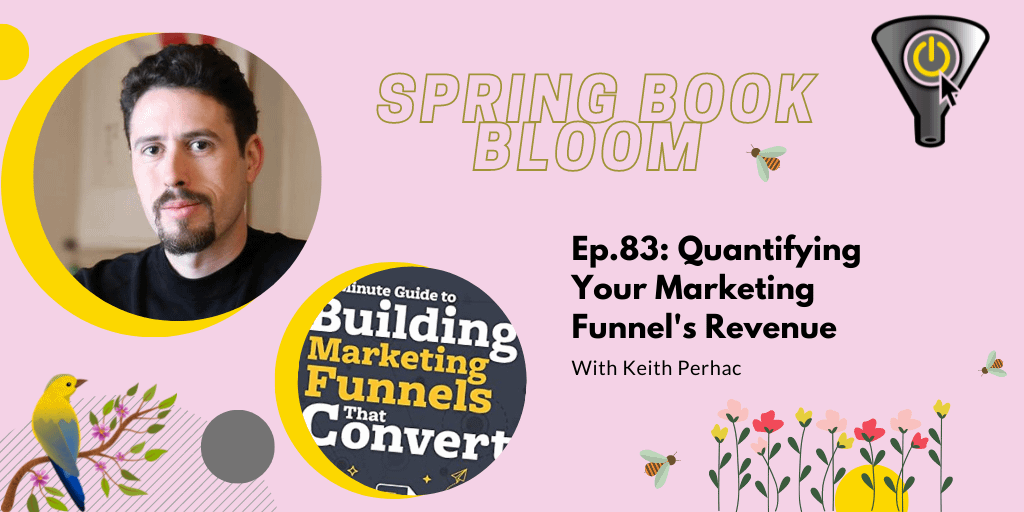
Episode 83: Quantifying Your Marketing Funnel’s Revenue with Keith Perhac

Disclaimer: The company featured here is not a sponsor of the show, nor have I affiliated with them. They simply bring a perspective that I think you’ll get some use from.

“It’s not working.” That’s the gist of every complaint made about marketing funnels. Marketers painstakingly build a series of offers and pay for traffic to see them, but the conversion rates drop off somewhere between there and the point where sales close.

Can funnels be fixed? Absolutely, but not without knowing a critical piece of data. Getting that data that helps fix the suboptimal parts of the funnel is our focus today. 

To go through this I’m joined by Keith Perhac, a digital marketing expert and software entrepreneur. After growing up in the states, he headed to Japan to become what’s known there as a salaryman. He moved back In 2010 to work with startups and digital marketers looking to grow quickly. He founded SegMetrics, a tool that lets you see revenue from the perspective of each touchpoint in your marketing funnel. Since then, he’s appeared on over 35 podcasts & in 2020 published the book we’re here to discuss, “Building Marketing Funnels that Convert, a 90 minute guide”

When he’s not working on SegMetrics, Keith draws and attempts (futilely) to spend more time outdoors. He lives in Portland, Oregon with his wife and two daughters.

People/Products/Concepts Mentioned in Show