Disclaimer: The company featured here is not a sponsor of the show, nor have I affiliated with them. They simply bring a perspective that I think you’ll get some use from.
“It’s not working.” That’s the gist of every complaint made about marketing funnels. Marketers painstakingly build a series of offers and pay for traffic to see them, but the conversion rates drop off somewhere between there and the point where sales close.
Can funnels be fixed? Absolutely, but not without knowing a critical piece of data. Getting that data that helps fix the suboptimal parts of the funnel is our focus today.
To go through this I’m joined by Keith Perhac, a digital marketing expert and software entrepreneur. After growing up in the states, he headed to Japan to become what’s known there as a salaryman. He moved back In 2010 to work with startups and digital marketers looking to grow quickly. He founded SegMetrics, a tool that lets you see revenue from the perspective of each touchpoint in your marketing funnel. Since then, he’s appeared on over 35 podcasts & in 2020 published the book we’re here to discuss, “Building Marketing Funnels that Convert, a 90 minute guide”
When he’s not working on SegMetrics, Keith draws and attempts (futilely) to spend more time outdoors. He lives in Portland, Oregon with his wife and two daughters.
Digital marketer isn’t one of those occupations that kids in school blurt out when they are asked “what do you want to be when you grow up?”
Thankfully, a book came out in 2019 that lays out very plainly many of the things I wish I’d known when I joined this profession. Becoming a Digital Marketer has elements that are tactical but it also weighs in on existential questions like ‘what kind of lifestyle can I have being in this field?’ and ‘should I work client-side, agency-side, or be my own boss?” Though I’ve been at this for decades, I’ll admit that I learned a number of things in the book, both about marketing and about Kombucha, which was the product used throughout the book’s marketing tales.
Once our guest, Gil Gildner, got out of school, he worked in media for NGOs, where he traveled to over 45 countries, wore hazmat suits in Ebola units, and rode Ugandan motorcycles. Realizing that he wanted to survive into his thirties, he started doing marketing for a company that sold around-the-world airfares. It’s in this company where he met his wife Anya, a paid search specialist. Listen to our conversation for more of the interesting story of how Gil and Anya wrote this book and founded an agency which they operate from wherever they are. Today he happens to be in his hometown of Fayetteville Arkansas, near Walmart world Headquarters
Disclaimer: The company featured here is not a sponsor of the show, nor have I affiliated with them. They simply bring a perspective that I think you’ll get some use from.
Two things are required to get a clear view of revenue growth. First, sales and marketing must come together to jointly-define the thresholds at each stage of a lead’s lifecycle. Second, they must apply points to a lead’s every action, either manually or by layering automation on this process.
My guest believes that lead scoring systems not only bring pipeline visibility, they improve the collaboration between Sales & Marketing. In fact, he claims that by pooling their information on leads and letting AI find the patterns, they can tell when a lead is ready to buy, upsell, or churn.
Gary Amaral held several positions at places like at BlackBerry & Hootsuite, always at the intersection of marketing and sales. Seeing how poor scoring led to frustration for all involved, he joined forces with two other serial startup entrepreneurs.
In 2020 they co-founded Breadcrumbs, which is a revenue acceleration platform based on a co-dynamic lead scoring and routing engine. Listen for Gary’s advice on what you need to do to get scoring right. Just as good communication helps keep couples together, the Sales & marketing relationship needs good communication on the status of leads. Lead scoring could very well be the glue in this marriage.
We all want to know how to improve the number of conversions we get on our websites. A lot of the time, we try to do that by rearranging the layout or switch up page elements. Then we go to our dashboards, see if the number went up or down. You’ve probably spotted the flaw in this. This is circular reasoning, a change in customer behavior can’t be proven by “looking back at data, trying to decide whether or not it was some sort of change that we made” As conversion expert, Matt Gershoff puts it. What’s the right way to do this? It’s simple, reverse the order of events and start off with your hunch about what you should change, run an experiment on your customers, proving or disproving if the thing you believe causes their behaviour actually has that effect.
This discipline is called CRO, which stands for Conversion Rate Optimization. There’s someone who’s superbly qualified to talk about this and I’m lucky to have known her for the past few years.
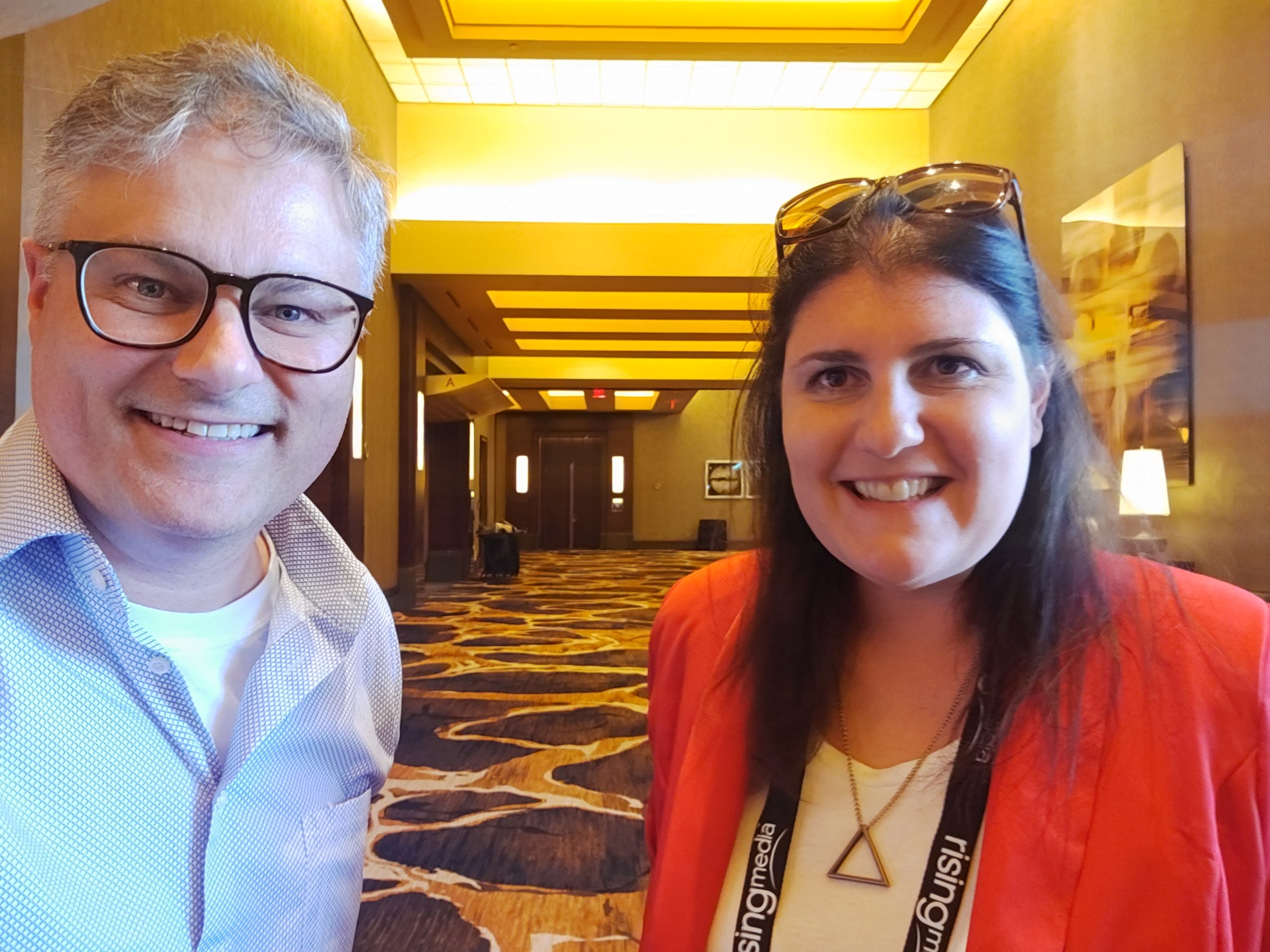
Deborah unknowingly ran her first optimization study in school at the age of 8, when she put her classmates through a science experiment where they looked at pieces of construction paper tacked on a bristol board. Little Deborah grew up to earn a master’s of science degree, specializing in eye tracking technology. Today, Deborah applies her specialized skillset to Conversion Rate Optimization (CRO). She founded a well known resource website where she has published hundreds of client A/B test case studies. She also has a certificate in graphic design, giving her the blend of left and right-brain thinking that’s just right for working in CRO.
Some things to listen for:
Marketers who run paid search & paid social will want to listen to what she has to say about mixing traffic from various channels together.
She explains what minimum traffic constraints we’re under for A/B tests, and why with small volumes we’re better to put 2-pages into a test where only 1 thing has changed, versus testing multiple pages or multiple variables at the same time
She has some tips on how we can maintain objectivity as we run our tests and as we present the results to our leadership.
People/Products/Concepts Mentioned in Show
Deborah’s Five Step Process:
1. Practice Know Your Audience (KYA) and research the performance of pages via site analytics and heatmaps like CrazyEgg and HotJar.
2. Form a SMART experiment hypothesis. Here is a single-sentence version: “Because I observed and received feedback on [what is causing users to convert at X rate], I believe that [the change to be tested] For [targeted segment or all users] will result in [specific lift in conversion rate].”
Ensure you have sufficient traffic / time for the experiment, using one of these calculators:
4. Run the experiment. Here’s a screenshot from one run using Google’s free tool
5. Implement the winning page and monitor for expected results.
How A/B pages are commonly named: “A” is your Control (original version) and “B’ is your Variant (includes change you’re testing). Here is a more in-depth Conversion Rate Optimization glossary
Note the different frameworks that tools use: Frequentist vs Bayesian frameworks. Depending on the statistical framework used, the timeframe needed to give results will change.
Disclaimer: The company featured here is not a sponsor of the show, nor have I affiliated with them. They simply bring a perspective that I think you’ll get some use from.
What needs to be done with marketing data to make it usable?
Essentially, it must be taken from its original source, formatted cleanly, and put into your database to be analyzed. This is handled by a process called ETL, Extract, Transform & Load. This process was done manually in olden days, but AI is now facilitating this task to be almost entirely done by technology.
Our guest can help us get familiar with how this works because he approaches it more from a marketer’s perspective than a technical one. JD Prater has a background in the world of paid media marketing, probably the niche that’s most famous for doing detailed analysis on large amounts of data. He has recently become Marketing Lead at Osmos, the maker of a tool that uses AI to help companies with ETL work. Besides that, JD has done marketing in-house at Amazon and Quora, and worked on brands while with a PPC agency. Besides that, he’s well known for speaking on digital marketing and being involved with several podcasts, and when he’s not on dad duty, you’ll catch him somewhere in his home state of Oklahoma, out cycling on an open stretch of road.